
MidAmerica Industrial Park points to long-term Google partnership as model for growth
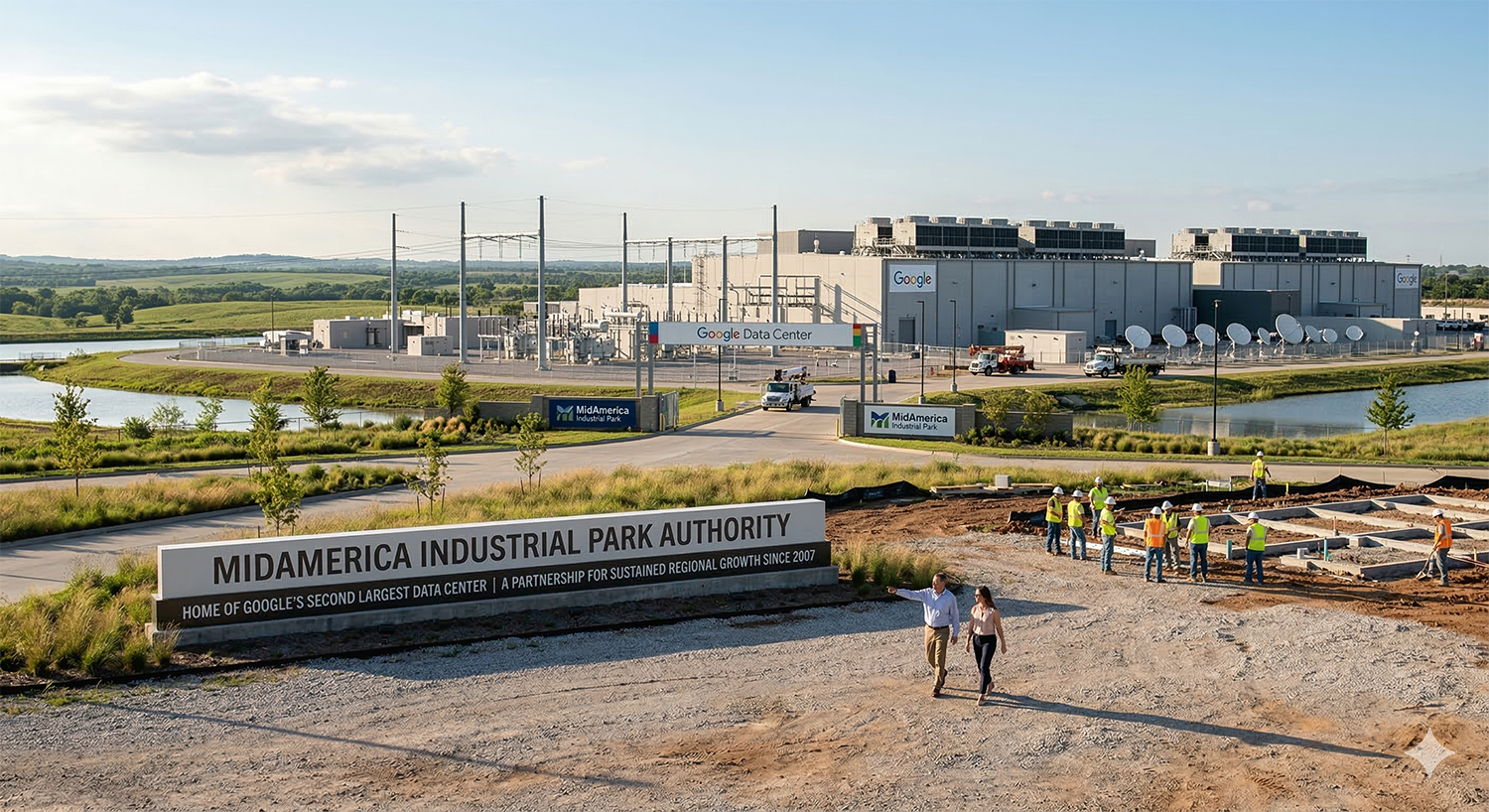 MidAmerica Industrial Park points to long-term Google partnership as model for responsible data center growth
As communities across the nation debate the impact of data centers, MidAmerica Industrial Park in northeast Oklahoma offers a nearly 20-year case study in how long-term planning, environmental diligence and strategic community investment can turn a major project into sustained regional growth.
Google purchased a pre-existing building at MidAmerica in 2007 and began operations in 2011. Today, its Mayes County facility is the company’s second largest data center in the world. For MidAmerica leaders, that scale reflects both corporate confidence and local readiness.
“Companies like Google do not invest billions of dollars in a location where a project could potentially fail,” said David Stewart, CEO and a member of the Board of Trustees for the MidAmerica Industrial Park Authority. “Every site undergoes rigorous due diligence – environmental studies, water resource analysis, power reliability assessments, and long-term infrastructure planning. Those standards must be met before a single shovel goes into the ground.”
Stewart said the Park’s experience demonstrates that concerns often raised in other communities can be addressed through preparation, transparency and performance.
“One of the most important lessons we have learned is that success is not just about landing a project,” he said. “It is about what you build around it and how you ensure the community benefits for generations.”
In Mayes County, one of the most visible benefits is the impact of ad valorem taxes generated by industrial investment. Those revenues have transformed the local school district, which is now widely considered one of the top systems in Oklahoma. The district does not rely on state public funding support for operations, a distinction few can claim.
“Ad valorem revenue has allowed our schools to invest in facilities, technology, and educators at a level that would not otherwise be possible,” Stewart said. “It has strengthened the entire community and positioned our students for success.”
Google’s impact on education extends beyond Mayes County. Through STEM initiatives, digital skills training, and educator support, the company has contributed to programs across contiguous counties, expanding access to technology-focused learning and workforce pathways throughout the region.
MidAmerica leaders also prioritized quality-of-life investments within close proximity to major employers. Less than 1,000 feet from the Google data center, the Park developed The District – a mixed-use retail and entertainment center – along with West 530, a multifamily residential community that is 100% leased and operating with a waiting list.
“The fact that families live, shop, and gather within steps of one of the largest data centers in the world speaks volumes about safety and security,” Stewart said. “These facilities are quiet neighbors, and they operate under strict security and environmental standards.”
The Park has committed additional land for a master-planned residential community featuring trails and park space. Construction is underway. Adjacent to the development, the Cherokee Nation – the largest tribal nation in the United States – recently opened a Child Development Center and Head Start facility, further supporting working families and workforce participation.
Stewart said the coordinated growth reflects deliberate planning rather than chance.
“We aligned infrastructure early – power, water, sewer, and transportation – and we paired industrial growth with housing, childcare, and recreation,” he said. “When you plan for the full ecosystem, you create stability.”
After nearly two decades, MidAmerica leaders view their partnership with Google as proof that responsible data center development can coexist with environmental stewardship, infrastructure integrity, and community advancement.
“Our experience shows that when standards are met and investments are thoughtful, a data center can become a catalyst,” Stewart said, “not just for economic growth, but for education, quality of life, and long-term regional prosperity.”