
Site Selector Perspectives on Data Centers
Site Selector Perspectives on Data Centers
Data centers are part of a rapidly expanding and increasingly influential industry. At its core, a data center is a physical, secure facility or building that houses an organization's IT infrastructure, including servers, data storage drives, and network equipment. Without data centers, there would be no cloud computing, no artificial intelligence, no online services. Business as we know it would be throttled. As the data center landscape expands, site selectors across the American South are considering various points and counterpoints to help them make the decision to recommend a community as a data center site.
Power, Land, and People
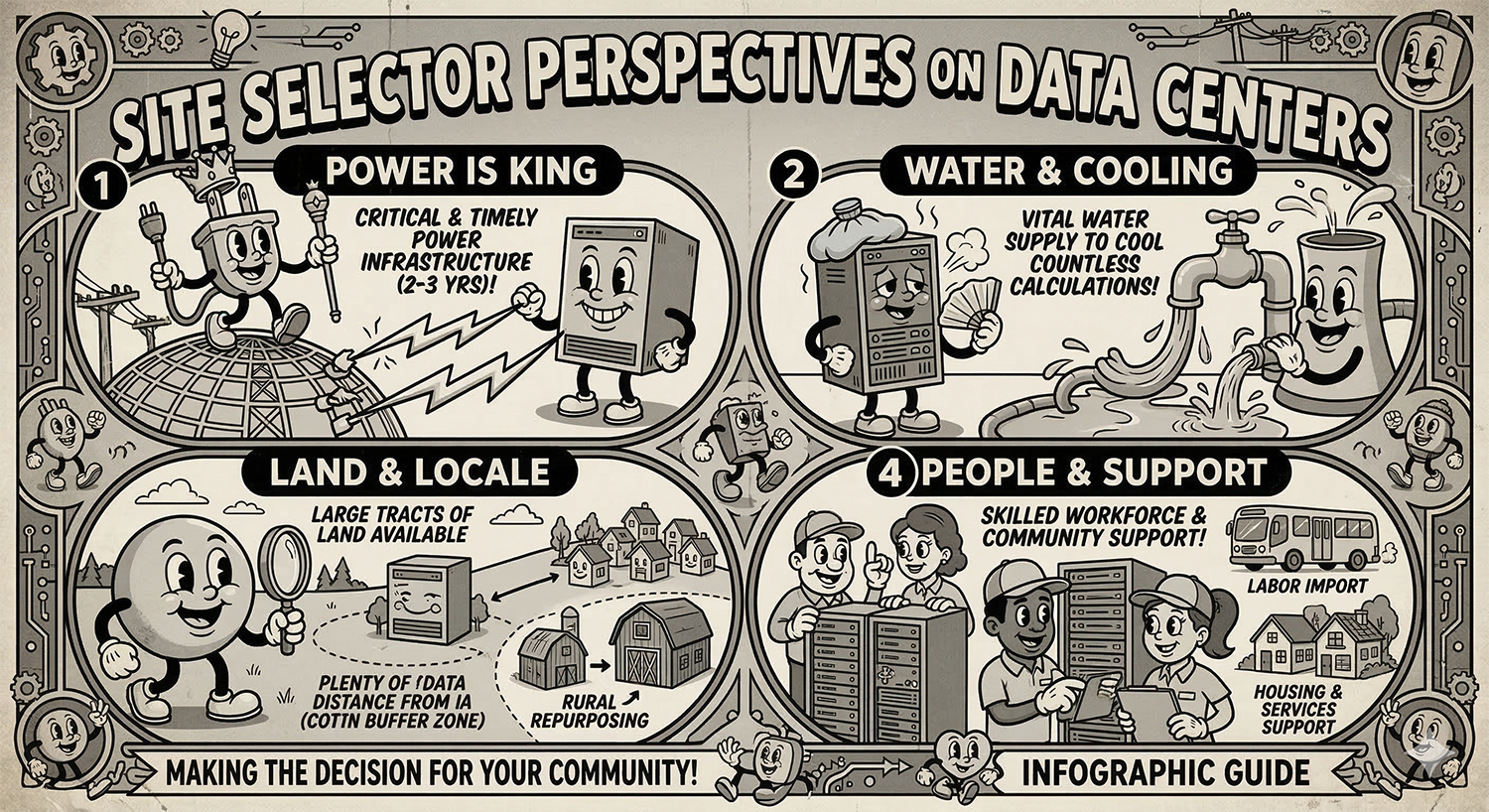
Several factors influence whether a location is considered suitable for a data center, but none is more critical than access to power infrastructure.
“Power is king,” said Chris Lloyd, Senior Vice President and Director of Infrastructure and Economic Development at McGuireWoods Consulting.
The ability to deliver power to a site within a reasonable development timeframe – typically two to three years – is the principal driving factor in site location. Power is so critical that some larger developers have even begun creating their own power on site.
Water availability is another vital requirement, needed to help cool the heat created by rows of electronic equipment running countless calculations.
Other factors that site selectors consider are whether large tracts of land are available, both for the center and for the ability to have buffers between the facility and residential areas. These requirements often position rural communities to be competitive in attracting data center investments due to both land availability and their proximity to existing power infrastructure. Rural communities may also have large facilities available that can be repurposed from a prior industry.
“For a rural community, the workforce is a big consideration,” said Courtland Robinson, a Director with Brasfield & Gorrie. “You can import a certain amount of labor to a new facility where a workforce for those data center occupations didn’t exist. But on some level, you need things to support the import of that labor, including housing, services and other things.”
Risk Calculus & Public Buy In
According to Tracey Hyatt Bosman, Managing Director of Biggins Lacy Shapiro & Company, “risk calculus” is another major factor for location consideration.
“The industry’s risk calculus has shifted,” Bosman said. “A decade ago, developers focused heavily on natural disaster exposure, avoiding flight paths, and physical security concerns. Today, power availability, interconnection timelines, zoning constraints, and community sentiment are far more likely to govern site viability.”
Data centers have become the subject of increased public and political scrutiny.
“Data center projects have become highly visible developments that often trigger broader debates about grid reliability, utility costs, environmental impacts, and quality-of-life considerations,” Bosman said. “As facilities expand into new markets and closer proximity to population centers, communities are demonstrating a greater willingness to challenge projects perceived as infrastructure-intensive or visually disruptive.”
Yes, communities weighing potential data center developments do face risks, such as appropriate land usage and ever-changing valuation of facilities. However, some widely circulated concerns, such as data centers making communities targets for terrorist attacks, are unsupported by data.
However, the exponential growth of the industry is, in itself, a risk.
“Concerns related to electricity demand, water usage, land use compatibility, aesthetics, and perceived economic benefits are influencing zoning decisions, permitting timelines, and political discourse at the regional, state, and local levels,” said Bosman. “In certain jurisdictions, resistance has resulted in moratoria, restrictive ordinances, or prolonged approval processes. Even where projects advance, developers increasingly face heightened scrutiny and organized public engagement.”
Some criticism has also stemmed from perceptions of the data center industry as a “dirty industry.” However, according to Lloyd, the industry has made significant progress, especially in decreasing noise pollution and emissions.
“These facilities are often exponentially more secure, exponentially more taken care of, and planned for well in advance, and maintained,” Robinson added. “I think the risk is in the unknown. The risk is in not understanding what these facilities do and how they operate and what is important to their bottom line.”
Data Centers and the American South
With the continued growth of artificial intelligence in an increasingly automated world, the data center industry will certainly see increased investment and demand. This trend is particularly evident across the American South due to available power, site availability, and a generally pro-business regulatory climate. Robinson cited population and infrastructure as the two primary factors that invite the industry southward.
“We have one of the more diverse and robust energy portfolios here in the Southeast than in many other parts of the country.”
Data center growth is already ballooning in states like Georgia, Texas, and Virginia. According to the American Edge Project, a policy advocacy coalition that tracks data center projects, Georgia has 285 data centers in the planning stages. Texas has a planned 442 projects to add to its 405 data centers already in operation. Meanwhile, Virginia remains the “data center capital of the world,” hosting 660-plus active facilities with nearly 600 more planned.